
Students help encourage volunteers for nonprofit organization, The Davies Project
Link to MSU article
Jazlyn Steins
October 23, 2026
Two students at Michigan State University are trying to help The Davies Project, a nonprofit organization based in Lansing, find ways to attract younger volunteers because of the increased demand for transportation services by people who have to receive medical treatment.
These two students, psychology junior Madison Lynch and psychology sophomore Sawyer Bigler, are collaborating with The Davies Project through MSU Social Science Scholars to find out how to motivate college students to volunteer.
The Davies Project helps people in the Greater Lansing region who face difficulties in receiving medical services because of transportation issues by transporting children suffering from severe illnesses, pregnant women and their families to medical appointments.
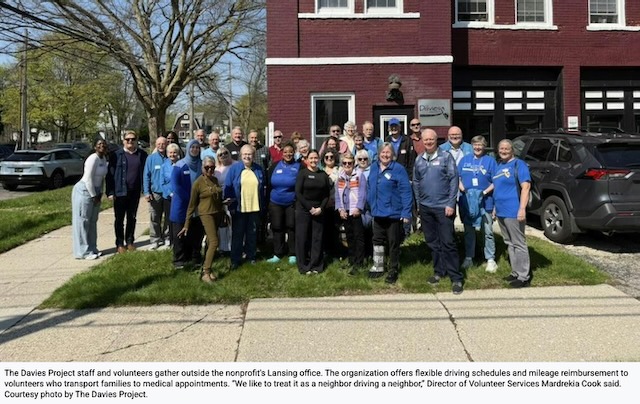
The organization currently has 65 volunteers who transport people but at one point had 75 volunteers in 2024, said Mardrekia Cook, the director of volunteer services for The Davies Project. The organization makes sure to provide 50 rides every week and has provided more than 4,300 rides in the previous year. Cook said many of the organization’s volunteers are retirees, making the recruitment of younger drivers increasingly important.
“We’re always going to be receiving people who need our services,” Cook said. “We need more people to help make our services go and make it extremely sustainable.”
Lynch and Bigler began working with the organization this past September after selecting it from a list of local nonprofits participating in their scholars program.
Lynch said she wanted to become involved because she had not volunteered as much since beginning college and hoped to reconnect with the community. Bigler, who is interested in pursuing medicine, said the Davies Project stood out because of the direct impact its volunteers have on families.
“I feel like Michigan State University is just such an untapped resource, and they don’t really know how to get around and get through it and navigate it,” Bigler said. “And so I feel like we can make a really big difference there.”
The students are researching volunteer recruitment strategies by contacting nonprofit organizations across the country and examining what motivates people to volunteer. They also plan to conduct focus groups with MSU students, particularly those in Lyman Briggs College, and organize informational tables in residence halls to increase awareness of the organization.
Lynch said the students have not recruited any volunteers yet, but hope to begin reaching students through these efforts.
“We’re going to start kind of having a presence on campus and trying to get like the name out there talking to students, so hopefully we start recruiting people soon,” Lynch said.
One challenge the students face is the organization’s minimum driving age of 20, which prevents some younger MSU students from becoming volunteer drivers. Cook said eligible drivers must also have a valid driver’s license, auto insurance, a working phone and pass a background check. Volunteers can choose when and how often they drive, and the organization offers mileage reimbursement.
The nonprofit also maintains a waiting list for families seeking rides, with Cook estimating that it can include five to 10 families, depending on volunteer availability.
For Lynch and Bigler, the project extends beyond recruiting drivers. By the end of the semester, they hope to produce a research paper outlining recruitment strategies that this nonprofit could use. Cook said the organization is piloting expansion into Kalamazoo County and discussing possible expansion into Omaha, Nebraska, making the students’ research useful beyond Lansing.
Lynch said she hopes their work will encourage students to recognize the importance of giving back to the community surrounding MSU.
“There’s a whole community outside of our little like kind of bubble that’s a college,” Lynch said.
Bigler said the project has reinforced how much of a difference volunteering can make.
“When you’re not volunteering, and you’re not really out there looking for volunteering hours, you kind of miss how important it is and how impactful, how much your time can mean to someone else,” Bigler said.


